Aaron’s doctrine of sacrifice
The Knife of Never Letting GoAaron’s doctrine of sacrifice presents violence as a means of revealing and purifying supposed hidden evil. It grows out of a history in which hardship is redirected into blame, and it reaches its sharpest personal form when Aaron casts Todd Hewitt’s refusal to kill as a failure to become a man. The doctrine’s force lies in joining those claims: violence is made to seem both morally necessary and proof of masculine identity, while those who resist it are told they have failed their purpose.
Historical Ground: Blame Becomes Violence
Ben describes New World as a place where everything communicates continually, an abundance of information that humans were not equipped to bear. Against that background, years of failing crops, sickness, and a lack of prosperity deepened hardship. Preaching spread that blamed the Spackle, and blame hardened into a movement and then a war. Ben emphasizes the unequal conditions: humans had guns and the Spackle did not. The war nearly destroyed the Spackle, and survivors learned to keep their distance from humans.
That history establishes a recurring pattern behind Aaron’s teaching: suffering is assigned to an outside group, and violence against that group is treated as an answer to the crisis. The account does not make Aaron the sole cause of the war; it places his later preaching within a wider movement of accusation. Its significance is that the same logic does not end with the Spackle. In Todd’s account, the men of Prentisstown later killed the town’s women and the men who tried to protect them. Ben confirms that many men were swayed by Mayor Prentiss and Aaron’s preaching, which treated what was hidden as evil. Todd names his mother among the dead, and Ben’s response confirms the loss.
The Doctrine Applied to Viola
Aaron applies the idea of concealed evil to Viola’s silence. He describes her presence in the swamp as a corrupting force and says that he believed God had sent him a sacrifice: an example of hidden evil to destroy and purify. His language turns a person into an object of a religiously framed act. Rather than recognize Viola as someone with her own purpose, Aaron interprets her through the role his doctrine assigns her: the victim whose destruction would demonstrate his authority to identify and remove evil.
That interpretation changes when Aaron decides that Viola’s presence has disclosed Todd’s supposed purpose. He casts Todd as the protector of the helpless, then argues that Todd’s flight from him was a refusal to fulfill his destiny. The contradiction is revealing. Aaron first defines Viola as the evil to be destroyed, then uses the danger she faces to give Todd a role in his own scheme. Her vulnerability becomes an instrument in his argument about Todd, not a reason to reject the violence Aaron is demanding.
Todd as the Test of Manhood
At the church, Aaron builds his challenge from earlier encounters. He recalls that Todd raised a knife in the swamp but hesitated, that he later pursued Viola after Aaron took her, and that he endured danger rather than let her come to harm. Aaron also invokes the death of Manchee, presenting Todd’s loss as further evidence that he has repeatedly failed to serve the violent purpose Aaron has assigned him. These recollections are Aaron’s interpretation of Todd’s actions, not proof that Todd accepts Aaron’s account of what those actions mean.
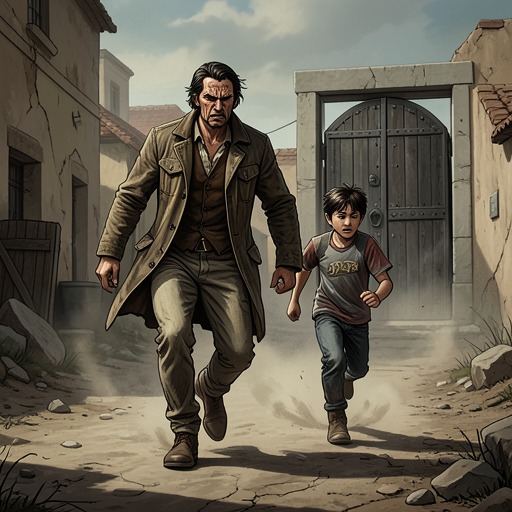
Aaron repeatedly joins killing to manhood. He tells Todd to fulfill his purpose and become a man, and he urges him to fall into the role Aaron has prepared. When Todd says he will act, he continues to move away rather than simply comply; later, even after falling and dropping the knife, he insists that he is already a man. The exchange puts the doctrine’s central demand under pressure: Aaron treats manhood as something proven by killing, while Todd’s refusal to accept that definition separates moral identity from the violence Aaron calls necessary.
Sacrifice, Complicity, and the Ending
The teaching’s communal consequences are visible in the history of Prentisstown. Men who tried to leave were killed under a system that turned boys’ thirteenth birthdays into occasions for killing. Todd learns that his former schoolteacher was killed by a boy in front of the town’s men, and that another man was executed after trying to escape. When no captured escapee was available, someone disliked in the town could be made to serve instead. Todd summarizes the resulting condition as shared guilt, with himself as the exception he believes he represents. The episode shows how a doctrine that presents violence as purification can enlist witnesses and institutions, not only the person who carries out the killing.
Aaron’s final demand makes the logic personal once more: he offers himself as the person Todd should kill, still claiming that murder would make Todd a man. The offer does not undo the doctrine’s earlier violence or make its demand ethically neutral. It reveals how completely Aaron has bound sacrifice to his definition of manhood: even his own death is presented as a tool for producing the identity he wants Todd to assume. The available scene ends with Todd rejecting that definition in words, though the encounter remains unresolved in the evidence here. Across its public and personal forms, Aaron’s doctrine converts fear into accusation, accusation into sanctioned violence, and violence into a test of belonging. Its counterpoint is Todd’s insistence that a person need not kill to count as a man.